

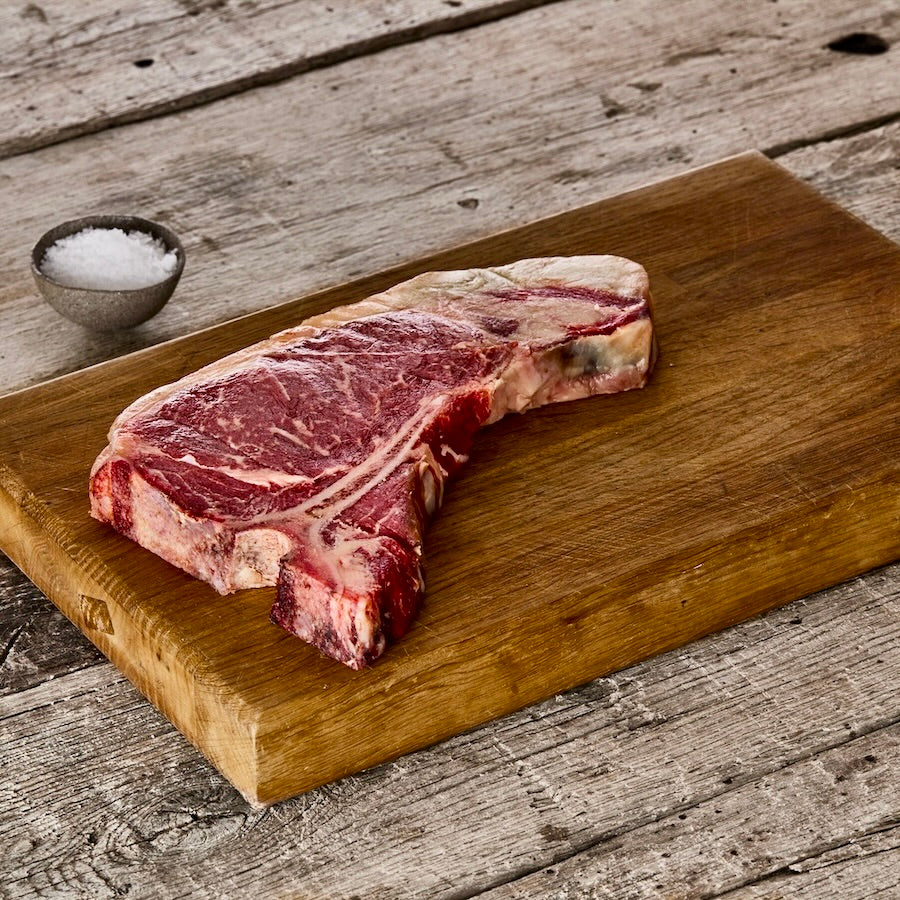
British Beef T-Bone 28 Day Dry-Aged | ±800g

Regular price
£39.50
Regular price
£39.50
Sale price
£39.50
Tax included.
2 Serve
North Yorkshire, England Origin
Native and rare breeds Breed
Grass Feed
28 days dry-aged Ageing
Description

Experience the exceptional flavour of this 28-day dry-aged British T-bone steak, a premium cut that combines the tenderness of fillet and the rich taste of sirloin. Elevate your meal by pairing it with our Chimichurri Butter for a luxurious finish, or enhance its natural flavors with a sprinkle of our Scottish Sea Salt Flakes. For a gourmet touch, consider serving it alongside our Tarragon Dijon Mustard, adding a delightful kick to your dining experience.

Browse our delicious pantry products to elevate your dish.

  • Grass-fed British beef, native and rare breeds
  • Reared in North Yorkshire
  • 28 day dry-aged
  • Cut in-house by our own butchers
  • 1 steak of ±800g
  • Serves 2
  • Frozen
Cooking Instructions

Dry-Aged T-Bone - Reverse Sear

±800g, 28 day dry-aged. Serves 2. Defrost 16 hours. Around an hour from fridge to table.

1. Defrost
Move the pack from freezer to fridge. Leave it in the vacuum pack, on a tray. Allow 16 hours. Cook within 48 hours of defrosting. Do not refreeze.

2. Understand what you are cooking
A T-bone is two steaks either side of one bone. The larger side is striploin, the smaller is fillet. The fillet is leaner, smaller and cooks faster than its neighbour, so the whole method is about getting them to finish together.

3. Salt and temper
Pat dry and salt generously on all sides. Leave it uncovered on a rack in the fridge for a few hours if you can. Out of the fridge 45 minutes before cooking.

4. Low heat first
Oven at 110°C on a rack over a tray. Cook until the striploin side reaches 46°C. Allow 35 to 45 minutes. Probe both sides. The fillet will be a few degrees ahead and that is expected.

5. Rest, then sear
Rest 10 minutes while you bring a heavy pan or barbecue to full heat. Sear 60 to 90 seconds a side. Keep the fillet side towards the cooler part of the pan or grill, and the striploin over the hottest part. On charcoal, stand the steak on its bone edge for a minute first.

6. Pull at 52°C on the striploin
The fillet will sit a little above it. Both will be medium rare, which is where grass-fed beef of this leanness eats best.

7. Rest properly
10 to 12 minutes on a board. Do not cover it tightly.

8. Carve both sides off the bone
Run a knife down each side of the bone to release the two muscles whole. Slice each across its own grain at 1cm, then lay the slices back around the bone to serve. Flaked salt and the board juices.

Nutritional Information
Typical values Per 100g
Energy
Fat
of which saturated
Carbohydrate
of which sugars
Fibre
Protein
Salt
Storage

Delivered frozen
Keep frozen at -18°C until needed. Use by the date on the pack.
Defrost in the fridge, in its packaging, on a plate. Allow 16 hours. The pack will release liquid as it thaws.
Never defrost at room temperature or in a microwave.
Once defrosted, keep at 0-4°C and cook within 2 days.
Do not refreeze once thawed.

Delivery

SHIPPING RATES (UK mainland only excl. Highlands)

 Orders over £85 Express By End of Day (Tues-Sat)  FREE
 Orders under £85 Express By End of Day (Tues-Sat)  £8.50
 Express by 1PM (Tues-Fri) / by 1PM for Scotland  £11
 Express Saturday by 1PM / by 1PM for Scotland  £22


Our delivery service covers all UK mainland addresses and is fully tracked using trusted courier DPD.
We aim to deliver all orders, excluding the Highlands & Islands, via next-day service; however, please allow up to 48 hours when placing your order in case of any courier delays.

FAQs
British Beef T-Bone 28 Day Dry-Aged | ±800g

  • Yorkshire's Rare Breeds

North Yorkshire is livestock country and always has been. Limestone dales to the west, heather moor to the east, and the broad green vale between them: ground that has always suited grazing better than crops. The grass comes slowly here, thick with herbs and old ryegrass leys, and the cattle come on slowly with it. Cool summers, wet autumns, and no reason to hurry.

It is also where the old breeds survived. Longhorn, Belted Galloway, Dexter, Red Poll, slow-maturing cattle that most of the industry abandoned for faster commercial crosses, kept on family farms and taken to a local abattoir a few miles down the road rather than hauled the length of the country. Slow growth lays fat inside the muscle rather than around it. Twenty-eight days on the bone then draws off the water and concentrates everything else.