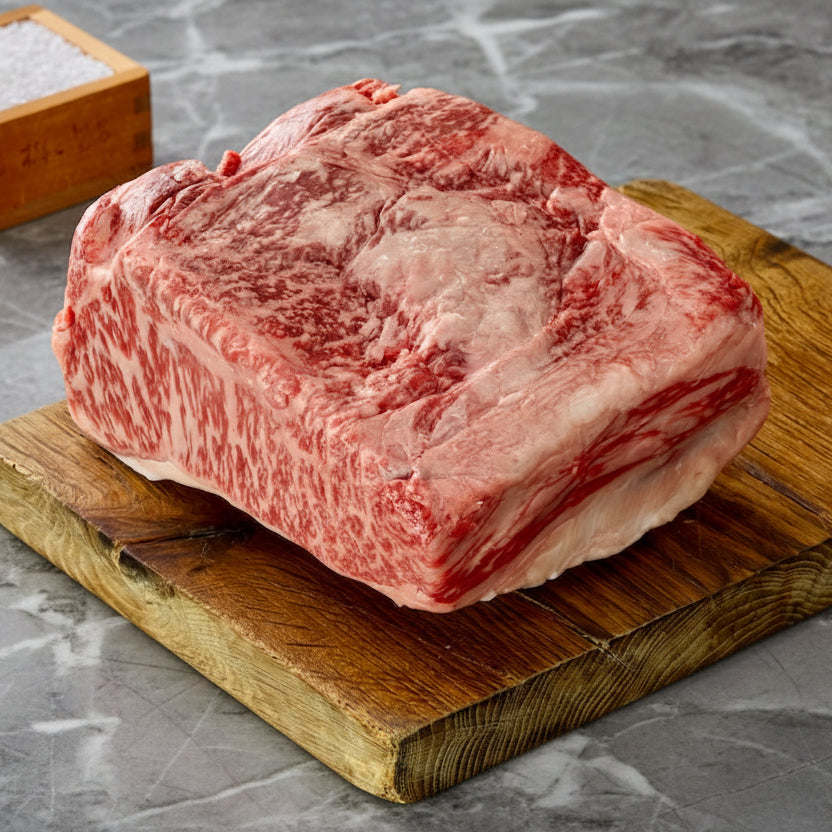

Wagyu Japanese Beef Whole Striploin

Regular price
£440.00
Regular price
£440.00
Sale price
£440.00
Tax included.
A3 to A5+ Grade
Kagoshima Prefecture - Japan Origin
Full blood Kuroge Washu Breed
Description

Japanese Wagyu Beef Striploin from Kagoshima Prefecture is celebrated for its unparalleled quality and exquisite marbling. Raised with meticulous care in a region known for its pristine environment and rich agricultural traditions, this cut offers a perfect balance of tender texture and rich, buttery flavour. Whether enjoyed as steaks or in traditional Japanese dishes like sukiyaki, Kagoshima Wagyu striploin promises a gourmet dining experience that delights both aficionados and newcomers to fine beef.

It is one of the most versatile cuts and there will be many ways for you to enjoy this striploin. Because of its richness, 100-gram portions should be plenty enough should you decide to cut steaks. We also recommend this cut for sukiyaki, shabu-shabu and yakiniku for epic culinary adventures.

  • Full blood Japanese Black Wagyu (Kuroge Washu)
  • Reared in the Kagoshima Prefecture (South of Japan)
  • Grade A3, A4, A5 & A5+
  • ±2.3kg, 3.3kg, ±4kg, ±5.5kg
  • Chilled
  • The picture shows a Grade A4

We strive for precision with every hand-cut order. Please note that natural variations occur, and we maintain a weight tolerance of ±8%, which is reflected in our pricing. Should a selection fall outside this range, we will contact you directly to ensure your order meets our standards and your expectations.

What is Grade?

Japanese Wagyu grading is a system used to classify the quality of Wagyu beef based on various factors such as marbling, meat colour, firmness, and texture. The grading typically ranges from A1 to A5+, with A5+ being the highest quality, characterised by abundant marbling, tenderness, and rich flavour.

Cooking Instructions

Japanese Wagyu Whole Striploin - Steaks, Sukiyaki or Shabu-Shabu

Kagoshima, Grade A3 to A5+. Portion it rather than roasting it whole.

1. Fresh or frozen
Check your pack. If it is chilled, keep it at 0-4°C in its unopened vacuum pack and cook by the date on the label. If it is frozen, thaw it in the fridge in its pack, allowing 28 to 40 hours depending on size.

2. Portion it, do not roast it
A whole A5 striploin is too rich to roast and carve like a joint of beef. Cut it into steaks, or slice it thin for the pot, and cook what you need.

Method A - Steaks (300g steaks, each serving two or three)

3. Cut across the striploin at 2½ to 3cm. Temper 30 minutes, pat dry and salt just before cooking.

4. Heavy pan over a medium-high heat for 3 minutes with nothing in it. Stand the steak on its fat edge with tongs for a minute, until the pan has a film of rendered fat. That is all the fat you will need.

5. Lay it flat. 90 seconds to 2 minutes a side, turning once. Spoon off the rendered fat as it pools. Pull at 54°C so the marbling renders fully and goes silky.

6. Rest 3 to 4 minutes only, then slice across the grain at 1cm and finish with flaked salt.

Method B - Sliced thin, for the pot (sukiyaki or shabu-shabu)

3. Firm a section in the freezer for 40 minutes, until it is solid at the edges but not frozen through. This is the only way to slice it thin enough by hand.

4. Slice across the grain as thin as your knife allows, 2 to 3mm. Lay the slices in a single overlapping layer on a cold plate and keep them in the fridge until the moment you eat.

5. For shabu-shabu, swish one slice at a time through a kombu broth held at a bare simmer, 5 to 10 seconds, until the colour turns from red to pink. Dip in ponzu or sesame sauce.

6. For sukiyaki, lay one or two slices flat in a shallow cast iron pan, 10 to 15 seconds a side, then add warishita and dip in beaten raw egg.

Do not season the slices. No salt, no oil, no marinade. The broth and the dipping sauces do all the work.

Storage

If fresh
Keep refrigerated at 0-4°C in its unopened vacuum pack and use by the date on the label. You can freeze it unopened at any point up to that date - at -18°C or below it will keep well for up to 12 months.

If frozen
Keep frozen at -18°C until needed. Use by the date on the pack.
Defrost in the fridge, in its packaging, allow 28-40 hours depending on size. Never defrost at room temperature or in a microwave.
Once opened or defrosted, keep refrigerated at 0-4°C and use within 24 hours. Do not refreeze once thawed.
A faint metallic smell on first opening the pack is normal for vacuum-packed beef and will disperse within a few minutes in open air.

Delivery

SHIPPING RATES (UK mainland only excl. Highlands)

 Orders over £85 Express By End of Day (Tues-Sat)  FREE
 Orders under £85 Express By End of Day (Tues-Sat)  £8.50
 Express by 1PM (Tues-Fri) / by 1PM for Scotland  £11
 Express Saturday by 1PM / by 1PM for Scotland  £22


Our delivery service covers all UK mainland addresses and is fully tracked using trusted courier DPD.
We aim to deliver all orders, excluding the Highlands & Islands, via next-day service; however, please allow up to 48 hours when placing your order in case of any courier delays.

FAQs
Will the whole piece be the same grade all the way along?

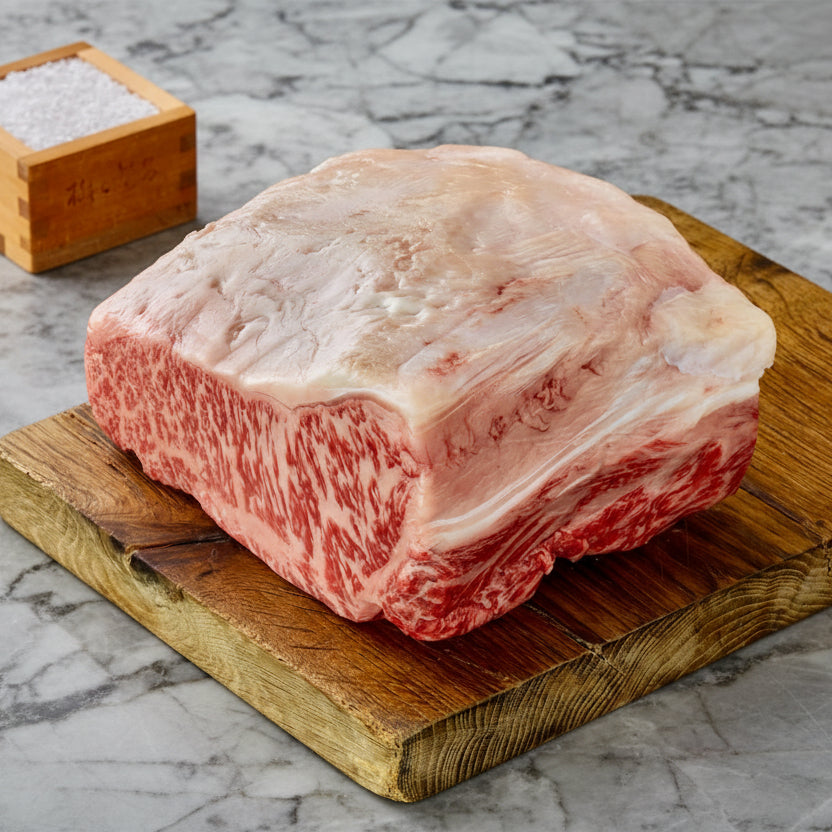
The grade is one number, but the marbling isn't uniform. Japanese carcasses are assessed at a single point, on the cut face between the sixth and seventh rib, and that reading is applied to the whole animal. A striploin runs a long way back from there, so expect the marbling to be at its most dramatic at the fore end and to ease off towards the tail. That's normal, and it's why the thin end suits slicing rather than steaks.

What do restaurants do with a whole striploin?

Much the same as we're suggesting: break it into steaks from the thick end, thin slices from the middle, and blocks or trimmings from the tail. Very little of it is cooked as one piece, even in kitchens with the equipment to do it.

What do I do with the trimmings and the fat?
Render the fat down slowly and keep it in a jar. It's the same thing we sell separately as Wagyu beef fat, and a spoonful transforms fried rice, eggs or potatoes. Any lean offcuts make exceptional mince or tartare.

Wagyu Japanese Beef Whole Striploin

  • Where Wagyu Began

Kagoshima sits at the southern tip of Kyushu, the last of Japan's main islands before the open sea. It is volcanic country. Sakurajima smoulders across the bay from the city and has been laying down ash for thousands of years, leaving a soil too loose to hold most crops but well suited to grazing and to the sweet potatoes the region is known for. Warm, wet, and a long way from Tokyo.

It is also the prefecture that raises more Wagyu than any other in Japan. The cattle are full-blood Kuroge Washu, bred from registered bloodlines and finished slowly, closer to thirty months than the twenty a commercial animal is given. Every one carries a ten-digit identification number that traces it back to the farm it was born on. Pedigree, time and record-keeping are the whole method. The marbling is what they produce.